
Self-hosted dereferer: anonymous redirect links
Suparedirect is a small Express server you run yourself. Link through it and the site on the other end gets the visitor without the Referer header, so it cannot tell which page sent them.
<a href="https://shop.example/pricing">GET /pricing HTTP/1.1 Host: shop.example Referer: https://forum.example/ Accept: text/html
shop.example learns that the visitor came from forum.example.
<a href="https://go.example/?to=https://shop.example/pricing">GET /pricing HTTP/1.1 Host: shop.example Accept: text/html
The line is not sent. document.referrer is an empty string.
Both requests are what shop.example receives, with other headers left out. The first one shows the browser default, which sends the origin of the linking page to another site.
One parameter makes an anonymous link
Put the target in to. The server answers GET /?to=<url> and nothing else needs configuring. A bare domain such as example.com gets https:// added in front.
A target that carries its own query string has to be percent-encoded, or everything after the first & is read as a separate parameter and dropped.
https://go.example/?to=https://shop.example/pricing
Your host, then the page to open.
https://go.example/?to=shop.example
Opens https://shop.example.
https://go.example/?to=https%3A%2F%2Fshop.example%2F%3Fa%3D1%26b%3D2
Opens https://shop.example/?a=1&b=2 with both parameters intact.
How the redirect drops the header
- The visitor clicks your link. Their browser loads a page from your Suparedirect host, not from the target.
- That page arrives with
Referrer-Policy: no-referreras a response header and the same policy as a<meta>tag. - A one-line script sets
window.locationto the target. The browser applies the page's policy to that navigation and sends noReferer.
The redirect is a script, so it needs JavaScript. With JavaScript turned off the visitor stays on a blank page.
The full mechanism and its limitssrc/index.ts, other headers trimmed$ curl -i 'http://localhost:3000/?to=https://example.com' HTTP/1.1 200 OK Referrer-Policy: no-referrer Content-Type: text/html; charset=utf-8 <!DOCTYPE html> <html> <head> <meta name="referrer" content="no-referrer"> </head> <body> <script> window.location = "https://example.com"; </script> </body> </html>
What it hides, and what it does not
A dereferer removes one piece of information. It is not a proxy or a VPN. The visitor's browser still connects to the target directly.
The target no longer gets
- The
Refererrequest header, including the origin - A value in
document.referrer
The target still gets
- The visitor's IP address and user agent
- Everything in the target URL, such as query strings and tracking parameters
- Its own cookies for that visitor
Your server gets
- The
Refererof the page that held the link, which it does not store - The target URL, the time and the user agent, kept in memory for the last 500 redirects
A dashboard for the redirects it served
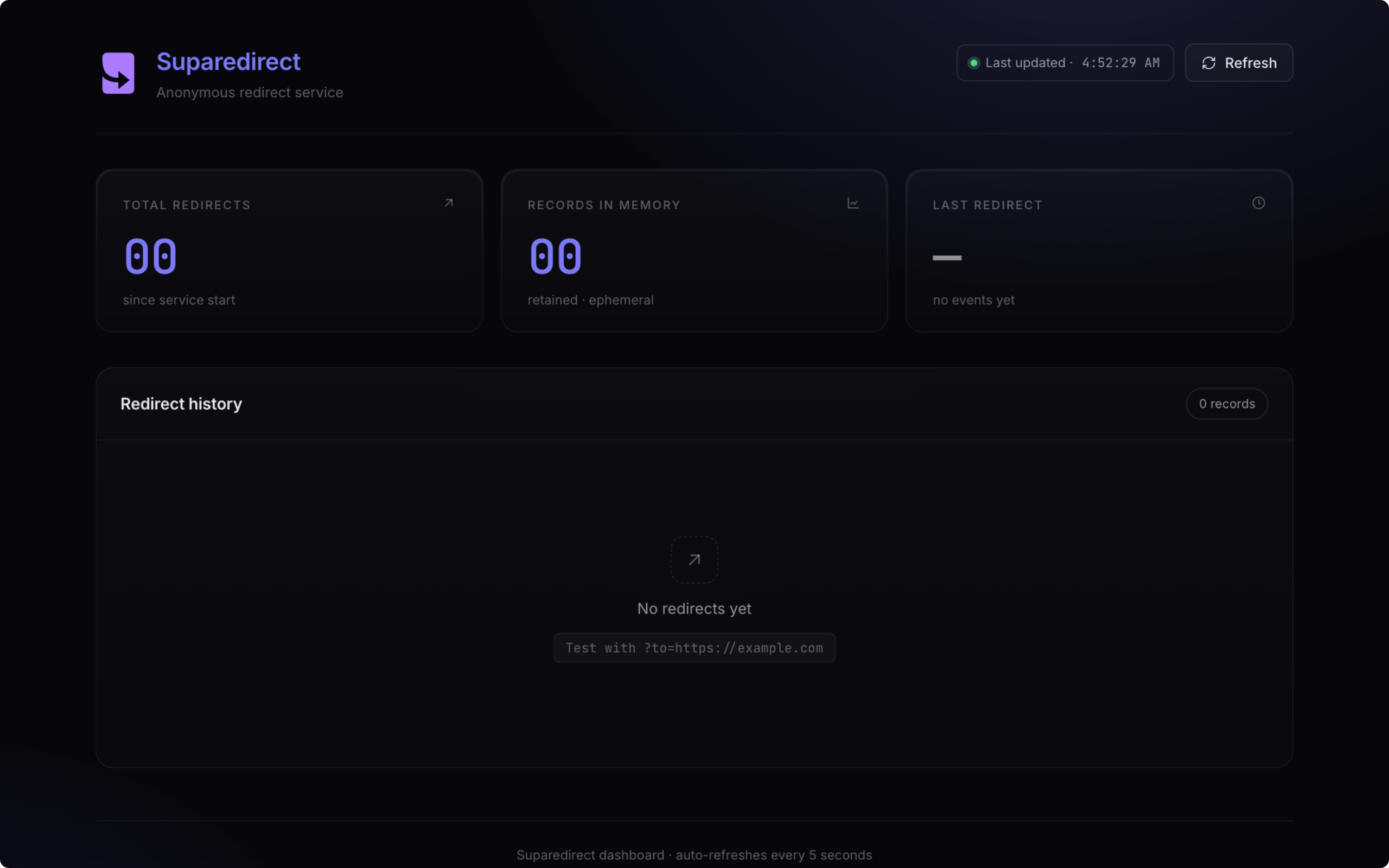
The image also serves a React dashboard on port 5173. It reads GET /api/stats every 5 seconds and lists the redirects held in memory. The counts reset when the process restarts.
Run it
The image is halitsever/suparedirect:latest on Docker Hub. The redirect server listens on port 3000 and the dashboard on 5173. Publish only 3000 if you do not want the dashboard.
From source you need Node.js and two installs, one for the server and one for the dashboard.
Step by step in the getting started guide# redirect server and dashboard docker run -p 3000:3000 -p 5173:5173 halitsever/suparedirect:latest # redirect server only docker run -p 3000:3000 halitsever/suparedirect:latest
git clone https://github.com/halitsever/suparedirect.git
cd suparedirect
npm i && npm run dashboard:install
npm run build && npm run start
You may not need a redirect at all
If you control the page that holds the link, rel="noreferrer" on the link or a Referrer-Policy header on the page gives the same result with no extra hop.
Suparedirect is for links on pages you cannot edit: a forum post, a wiki page, a chat message, a CMS you do not run. There you can only choose the URL, so the URL has to do the work.
Compare the three options<a href="https://shop.example/pricing" rel="noreferrer">Pricing</a> <!-- or for every link on the page --> <meta name="referrer" content="no-referrer">
Guides
- Getting startedRun the Docker image or build from source, then make your first anonymous link.
- How it worksThe redirect page line by line, and what it hides and does not hide.
- The Referer header explainedWhat browsers send, when they trim it, and whether it can be spoofed.
- noreferrer and Referrer-PolicyWhen an attribute or a response header does the job without a redirect.
- Stats dashboardWhat the dashboard on port 5173 shows and where the numbers come from.
- Self-hosting notesThe fixed port, in-memory stats, the open stats endpoint and reverse proxies.
- Dereferer services comparedHosted dereferers against one you run yourself, and what to check in either.